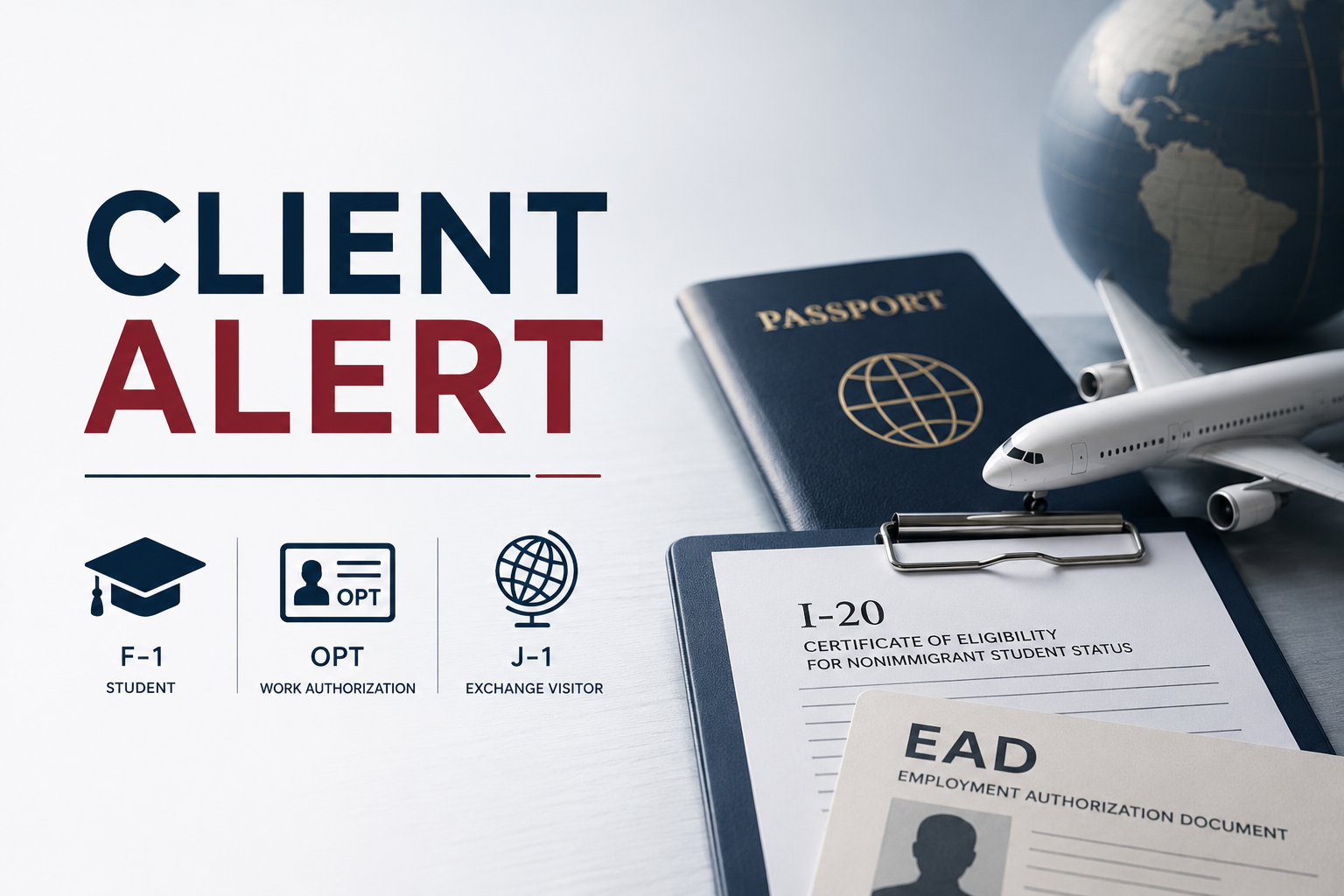
HIGH IMPACT – Affects: F-1 (incl. OPT / STEM OPT), J-1, and I Nonimmigrants Downstream Effects: H-1B cap-gap pipeline, work-authorization continuity
STATUS AS OF JUNE 18, 2026: The White House Office of Information and Regulatory Affairs (OIRA) concluded its review of the final rule on June 17, 2026, with the disposition “Consistent with Change”. This is the Office of Management and Budget clearance that precedes publication, but the final rule text has NOT yet been published in the Federal Register. Publication is expected imminently. Until it is published, every provision described below reflects the August 2025 proposed rule (NPRM), not confirmed final law.
What Changed
The U.S. Department of Homeland Security (DHS), through U.S. Immigration and Customs Enforcement (ICE), is finalizing a rule that would eliminate “Duration of Status” (D/S) admission for F (academic students), J (exchange visitors), and most I (representatives of foreign information media) nonimmigrants. The proposed rule, “Establishing a Fixed Time Period of Admission and an Extension of Stay Procedure for Nonimmigrant Academic Students, Exchange Visitors, and Representatives of Foreign Information Media,” 90 FR 42070 (Aug. 28, 2025), FR Doc. 2025-16554, RIN 1653-AA95, DHS Docket No. ICEB-2025-0001 drew more than 34,800 public comments, the majority opposed. DHS submitted the final rule to OMB/OIRA on May 5, 2026; OIRA concluded review on June 17, 2026.
Under current law, F, J, and I nonimmigrants are admitted for “duration of status”, meaning they may remain in the United States as long as they comply with the terms of their program, with no fixed “admit-until” date on the Form I-94. The rule would replace D/S with admission for a fixed time period tied to the program end date on the Form I-20 (F) or DS-2019 (J), capped at four years. To remain beyond the fixed period, the nonimmigrant would have to file an affirmative Extension of Stay application; the NPRM contemplated Form I-539 with biometrics, though the final rule may re-designate the form.
The NPRM also proposed several collateral changes, each of which should be treated as inferred until the final text publishes:
- Cutting the F-1 post-completion grace period from 60 days to 30 days.
- Restricting program, major, and education-level changes and school transfers during the first year for undergraduates and barring graduate students from changing programs once enrolled.
- Capping English Language Training at 24 months aggregate
- Most significant for compliance exposure: unlawful presence would begin to accrue automatically the day after the fixed admission period expires, rather than only after a formal finding by USCIS or an immigration judge, as under current policy. This is the sleeper risk; see Impact Analysis below.
This is a revival of the substantially similar D/S rule DHS proposed in September 2020, which the prior administration withdrew in July 2021 without finalizing.
Who is Affected
Employers with any foreign-national population that touches the F, J, or I categories should treat this as a workforce-planning matter, not just a campus or student-services issue. The most directly affected groups are: F-1 employees working on post-completion OPT and STEM OPT; candidates in the F-1-to-H-1B “cap-gap” pipeline awaiting an October 1 start date; J-1 researchers, scholars, professors, physicians, and trainees/interns on multi-year appointments; employees pursuing multi-year graduate or PhD programs part-time while employed; and I-category foreign media personnel. Downstream, this reaches talent-acquisition, global-mobility, and I-9 / work-authorization compliance functions because a person’s admission period and their employment-authorization document (EAD) validity could diverge.
Impact Analysis
| Impact Level | Description |
| High | Automatic unlawful-presence accrual. If the fixed period expires before status is extended, unlawful presence would begin accruing automatically, with no agency notice, exposing the employee to the 3-year and 10-year reentry bars under INA § 212(a)(9)(B)(i), 8 U.S.C. § 1182(a)(9)(B)(i). Today, F/J/I in D/S generally do not accrue unlawful presence until USCIS denies a benefit finding a violation or an immigration judge so orders. Work-authorization continuity gap. The fixed admission period and OPT/STEM, OPT EAD validity may diverge; an employee could hold a facially valid EAD while the underlying admission period lapses. Confirm I-9 / reverification handling once final. H-1B cap-gap disruption. The bridge from F-1 OPT to an October 1 H-1B start could be undercut if the fixed period expires before October 1; cap-gap mechanics under the new framework are unresolved. New Extension-of-Stay filing burden. Affirmative I-539 + biometrics filings (per the NPRM) add processing-time risk and potential status gaps for in-progress degrees, multi-year PhDs, and long J-1 appointments. |
| Watch & Monitor | Grace-period compression. A 60→30-day cut shortens the window to depart, change status, or transfer after completion. Reduced flexibility for early-career talent. First-year limits on program/level/major changes and undergraduate transfers. English Language Training. 24-month aggregate cap affects pre-degree / language-track hires. Transition for current D/S holders. NPRM contemplated assigning a fixed period off the existing I-20/DS-2019, capped at four years from the effective date, with a possible ~6-month OPT/STEM-OPT filing grace window – mechanics unresolved. I-129 deference policy. Open whether the final rule addresses or defers the deference-policy codification to separate rulemaking. |
Recommended Actions
No client filing deadline is triggered yet as the final rule is not published. The effective date will be set 30–60 days after Federal Register publication (NPRM-era estimates lean 60 days). USILAW will issue a follow-up alert with the confirmed effective date and any transition deadlines.
- Inventory your F-1 (incl. OPT/STEM OPT), J-1, and I population now. Map each person’s program end date, EAD validity, and projected H-1B / green-card timeline so you can model exposure the moment the final text publishes.
- Prioritize the highest risk cases. Anyone whose program or appointment runs beyond a likely 4-year cap, or whose OPT/STEM-OPT EAD extends past their projected fixed admission date.
- Brief hiring managers and affected employees that, if finalized as proposed, overstaying the fixed period could trigger automatic unlawful presence and multi-year reentry bars, not merely a status lapse.
- Build Extension-of-Stay lead time into workforce plans, and counsel affected employees to avoid international travel close to admission-period expiry.
- Coordinate H-1B cap-gap cases with USILAW to confirm the bridge to October 1 start dates survives under the final framework.
Do not act on specifics until the Federal Register text publishes. Hold for the USILAW follow-up alert confirming final provisions, the effective date, and transition rules for current D/S holders.
About this Alert
This alert was prepared by USILAW based on the proposed rule at 90 FR 42070 (Aug. 28, 2025), FR Doc. 2025-16554, RIN 1653-AA95, DHS Docket No. ICEB-2025-0001, and the OIRA review record for that RIN. Because the final rule has not yet published in the Federal Register, all descriptions of the final rule’s contents are inferred from the proposed rule and are subject to change. This alert is intended for general informational purposes only, is current as of June 18, 2026, and does not constitute legal advice. All date-sensitive content must be re-verified as of the date of distribution. Please contact your USILAW attorney with questions specific to your organization.
Questions? Contact your USILAW attorney directly or reach us at: