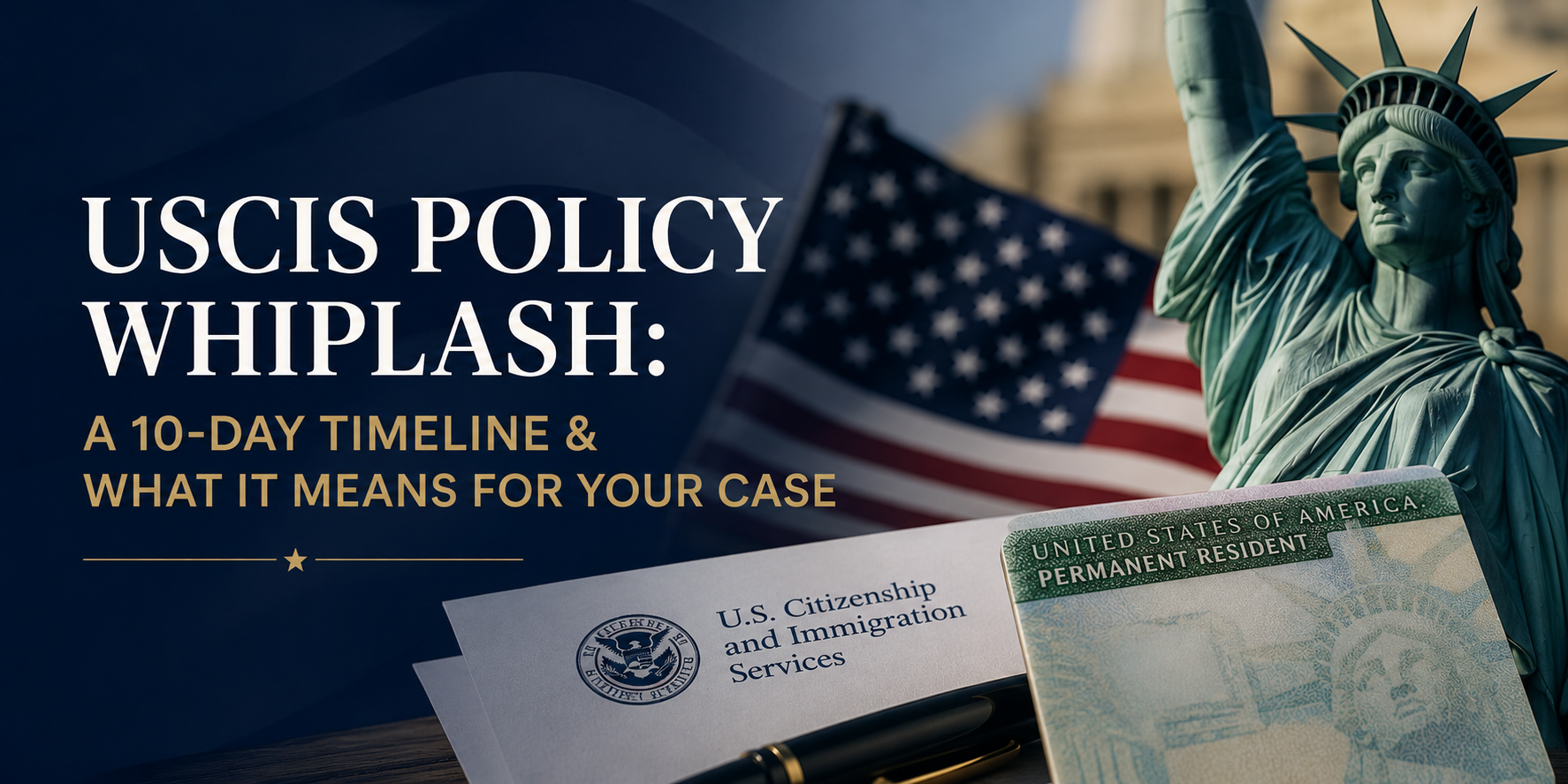
Ten days ago, USCIS issued a policy memo that appeared to fundamentally upend how the U.S. grants green cards. Headlines declared that immigrants on temporary visas would have to leave the country to apply.
Employers panicked. Immigration attorneys issued emergency alerts. Then came a partial walk-back. Then another. And by Friday, May 29, DHS was claiming there had never been a major policy change at all. This has caused unnecessary confusion and anxiety within the foreign national community.
The following memo provides a clear account of what happened, where we are now, and what it means for your case.
What Happened: A 10-Day Timeline
| May 21, 2026 | USCIS issued Policy Memorandum PM-602-0199, instructing officers to treat Adjustment of Status (AOS) as “extraordinary discretionary relief” and not a standard benefit. The agency’s own press release went further, declaring that immigrants on temporary visas seeking green cards must return to their home countries to apply through consular processing, except in extraordinary circumstances. Of the 1.4 million green cards granted in 2024, roughly 820,000 were approved through adjustment of status. The practical stakes were significant. |
| May 23, 2026 | USCIS Spokesman Zach Kahler partially softened the announcement. People providing an “economic benefit or otherwise in the national interest” would likely be able to continue their current adjustment path. No definition of either term was provided. |
| May 29, 2026 | DHS issued further clarification: this was not a blanket policy change. Individual officers have always had discretionary authority to determine whether someone must leave the country to apply. The memo, DHS now said, was simply “a reminder to officers of their discretionary authority, which has always existed on a case-by-case basis.” |
| May 30, 2026 | The New York Times reported that a senior White House official, speaking on condition of anonymity, described the effort as “a housekeeping matter, not a change of strategy.” Even some inside DHS had been confused about the scope of the change when it was first announced. |
The bottom line: The administration announced a sweeping policy change, walked it back twice in 10 days, and now characterizes it as routine guidance. That signals internal disagreement about the scope and intent of the memo, and it means the legal and operational landscape remains unsettled.
How the Business Community Responded
The original announcement drew swift criticism from some of the nation’s most influential business voices. Neil Bradley, Executive Vice President and Chief Policy Officer at the U.S. Chamber of Commerce, acknowledged the administration’s broader immigration enforcement goals but was direct about the operational impact:
“[The policy change] could be incredibly disruptive for employers.” The Chamber called for a “more robust” legal immigration system, not a more restrictive one.
— Neil Bradley, EVP & Chief Policy Officer, U.S. Chamber of Commerce
For employment-based clients, the Chamber’s response matters. It signals that employment-based immigration has meaningful political protection and that the DHS clarification was, at least in part, a response to that pressure.
What We Are Seeing
Despite the walk-backs, this memo has real operational consequences. USCIS continues to accept and adjudicate I-485 applications, but the prior status quo has not been restored.
- Heightened scrutiny is already here. We are seeing increased questioning at AOS interviews and are aware that RFE’s have been issued asking an applicant to affirmatively explain why adjustment of status was pursued rather than consular processing abroad. That is a direct product of the memo’s directive to officers.
- Implementation is inconsistent. Officers have been given broad discretionary authority and limited operational guidance. That variance makes the strength of your individual case file more important than ever.
- The memo remains in effect. DHS’s “housekeeping” characterization does not change the legal reality: PM-602-0199 is a stark reminder to Officers regarding USCIS policy at it relates to AOS. Officers are applying this framework today.
Who Is Most Affected
| Population | Risk Level | Key Concern |
| H-1B / L-1 with clean record (dual intent) | LOWER | These categories were designed to accommodate long-term immigration plans. Dual intent is recognized, but clean status history and proactive documentation are now expected. |
| EB-1 / EB-2 applicants with strong employment record | LOWER | Best positioned under the “economic benefit” carve-out. Economic contribution maps directly to DHS’s stated priorities. |
| O-1 holders with extraordinary ability credentials and clean records | ELEVATED | Well-positioned to demonstrate economic benefit and national interest under the DHS carve-out, though they lack the statutory dual-intent protection of H-1B and L-1 holders. |
| TN, or other non-dual-intent categories | HIGHER | No explicit dual-intent protection. Officers will scrutinize the transition to permanent residence more aggressively. Consular processing is likely the most suitable strategy, though individual case strategy review is essential. |
| Employment-based applicants with status gaps or unauthorized employment | HIGH | Officers are explicitly directed to treat immigration violations as significant adverse factors. Immediate case review is not optional. Previously, a minor historical gap might have been overlooked or treated as immaterial. Under the new framework, the officer must affirmatively address it. |
What USILAW Recommends: Action Items
If you have not filed an I-485:
For most individuals not yet at the I-485 stage, no immediate action is required. We recommend the following:
- Maintain valid immigration status and avoid any violations. A clean record is your most durable asset in a discretionary environment.
- Do not alter your immigration strategy based on the DHS walk-back alone. The memo remains in effect. Monitor developments as litigation and implementation guidance emerge.
- Continue building your equitable record: consistent employment, tax compliance, family and community ties, and length of lawful U.S. residence all function as positive discretionary factors.
If you expect to file an I-485 soon:
- Schedule a case strategy review with your USILAW attorney before filing. While USCIS has not yet issued detailed implementation guidance, applicants should expect increased attention to factors supporting adjustment of status in the United States rather than consular processing abroad. Eligibility on paper is no longer the only question.
- Identify and document your positive factors proactively. Depending on the facts of your case, these may include long-term lawful residence in the United States, continuous employment history, tax compliance, family ties, community involvement, and other evidence demonstrating strong connections to life in the United States.
- Evaluate whether consular processing is a viable alternative. For applicants in non-dual-intent categories, your attorney may recommend a different pathway based on the specific facts of your case.
If your I-485 is already filed and pending:
- Do not submit unsolicited additional evidence. In most cases, documents sent without a formal RFE will not be associated with your file and will not help your case.
- Work with your USILAW attorney to evaluate your case proactively. The first RFEs under this memo have already been issued. Preparation is the right posture, not reaction.
- Do not assume your approved I-140 petition protects your I-485. Each is a separate adjudication. An approved petition is a meaningful positive factor, not a guarantee.
What Has Not Changed
Notwithstanding the past 10 days of policy uncertainty, PM-602-0199 does not alter the following:
- The statutory eligibility criteria for AOS under INA § 245 remain unchanged.
- Priority date retention, I-140 portability, and visa bulletin rules are unaffected.
- H-1B and L-1 holders with clean records remain in a substantially stronger position than parolees or overstays.
- Certain non-discretionary AOS categories (e.g., Special Immigrant Juvenile) are not subject to this discretionary analysis.
- The right to file an I-485 when otherwise eligible has not been restricted.
What to Expect Next
USILAW is monitoring three parallel tracks that will determine how this policy evolves:
Legal Challenges
Court challenges are anticipated, and the memo faces real legal exposure. Leading immigration scholars have questioned whether USCIS has the authority to reframe a statutory benefit as extraordinary relief through internal policy guidance alone. Importantly, the Supreme Court’s Loper Bright decision, which eliminated the doctrine of judicial deference to agency interpretations of ambiguous statutes (“Chevron deference”), means courts can now independently assess whether PM-602-0199 is consistent with INA § 245, without deferring to USCIS’s reading. That makes this memo more legally vulnerable to challenge, not less. That said, the memo is in effect today. Plan based on current policy, not anticipated outcomes. USILAW will issue an immediate update if any court issues a stay or injunction.
USCIS Operational Guidance
DHS has not yet defined what “economic benefit”, or “national interest” means in the context of I-485 adjudication. That definition will be the most consequential piece of follow-on guidance for employment-based clients. We expect additional policy updates and potentially standardized RFE language as adjudication patterns develop.
Adjudication Trends
Implementation is inconsistent. Early signals point to increased scrutiny at interviews and an emerging RFE pattern asking applicants to justify adjustment of status over consular processing. USILAW is tracking denial rates, RFE language, and interview developments across our case portfolio in real time. Further updates will follow.
USILAW Is Monitoring Developments Closely
This memo is part of a broader pattern of USCIS policy actions this year that are reorienting discretionary adjudications toward heightened scrutiny. Well-prepared cases with strong discretionary records, clean status histories, and proactive legal strategy are the best defense in an environment of inconsistent implementation and evolving guidance.
We understand this is unsettling news for families and employers who have been planning around pending I-485 filings. Our job is to make sure your case is in the strongest possible position. We encourage immediate action before an RFE or denial forces the issue.
To schedule a case review, contact your USILAW attorney directly or reach us at